Common Legal Traps for Foreign Owned Companies in Indonesia
Foreign-owned companies in Indonesia often face legal risks not because of bad faith, but due to structural and regulatory misunderstandings. This article highlights common legal traps—from nominee arrangements and licensing issues to contract and land risks—and explains how foreign investors can avoid costly disputes through proper legal planning. Foreign-owned companies in Indonesia face hidden legal risks. Learn the most common legal traps and how to avoid costly disputes through proper structuring.
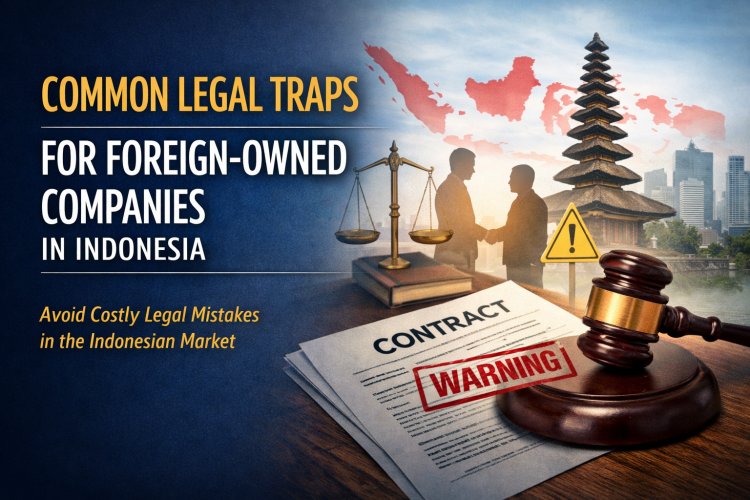
Common Legal Traps for Foreign-Owned Companies in Indonesia
What Foreign Investors Often Overlook—and How to Avoid Costly Mistakes
Indonesia remains one of Southeast Asia’s most attractive markets for foreign investment. With strong domestic demand, strategic location, and continuous regulatory reform, many foreign investors establish Foreign-Owned Companies (PT PMA) to operate legally in Indonesia.
However, beneath the opportunity lies a complex legal landscape. Many foreign-owned companies encounter serious legal problems—not because of bad intentions, but because of assumptions, informal practices, or incomplete legal structuring.
Below are some of the most common legal traps foreign-owned companies face in Indonesia—and why early legal awareness matters.
1. Using Nominee Arrangements Without Understanding the Risk
One of the most frequent and dangerous traps is the use of nominee shareholders or directors, particularly where foreign ownership restrictions apply.
While nominee structures may appear practical or “common practice,” Indonesian courts have repeatedly shown that:
-
Nominee agreements may be declared invalid
-
Beneficial ownership claims can be rejected
-
Control over assets and shares can be lost entirely
Key risk:
When disputes arise, written nominee agreements often provide little protection if they contradict mandatory Indonesian law.
What to do instead:
Use lawful ownership structures, proper shareholder arrangements, and clear corporate governance mechanisms that comply with prevailing regulations.
2. Establishing a PT PMA Without Proper Business Licensing Alignment
Many foreign companies successfully incorporate a PT PMA—but fail at the next step: aligning actual business activities with licensed business classifications (KBLI).
Common mistakes include:
-
Operating outside the approved KBLI scope
-
Relying on outdated licenses
-
Assuming incorporation alone permits full operations
Consequences may include:
-
Administrative sanctions
-
Business suspension
-
Invalidation of contracts
-
Difficulty obtaining future permits or approvals
Practical note:
Indonesia’s licensing system is activity-based. What your company does matters as much as what is written in its deed.
3. Weak Shareholder and Director Agreements
Foreign investors often rely on standard articles of association without additional shareholder agreements, assuming corporate law alone is sufficient.
This becomes problematic when:
-
Local partners control day-to-day operations
-
Decision-making authority is unclear
-
Exit mechanisms are not defined
-
Deadlock situations arise
Legal reality:
Without clear contractual arrangements, disputes may escalate into prolonged litigation with uncertain outcomes.
Best practice:
Well-drafted shareholder and director agreements are essential to protect voting rights, profit distribution, and management control.
4. Signing Contracts Without Proper Legal Review
In Indonesia, contracts are often drafted quickly—sometimes bilingually, sometimes informally. Foreign companies may sign agreements that:
-
Contain vague obligations
-
Lack governing law or dispute resolution clauses
-
Conflict with mandatory Indonesian regulations
-
Assign excessive liability to one party
Hidden risk:
A contract that “looks fine” commercially may be difficult—or impossible—to enforce legally.
Recommendation:
Legal review before signing is significantly less costly than resolving disputes later.
5. Underestimating Employment and Labor Law Obligations
Indonesia’s labor laws are employee-protective and strictly enforced.
Foreign-owned companies often face issues related to:
-
Improper termination procedures
-
Non-compliant employment contracts
-
Misclassification of consultants vs employees
-
Foreign worker permit (RPTKA & KITAS) violations
Resulting exposure:
-
Labor disputes
-
Government sanctions
-
Reputational damage
Important:
Employment disputes frequently escalate quickly and can disrupt business operations if not handled correctly.
6. Assuming Land and Property Used by the Company Is “Secure”
Many foreign-owned companies use land or buildings under arrangements that are:
-
Not registered under the company
-
Subject to third-party ownership claims
-
Encumbered by mortgages or disputes
Critical misunderstanding:
Control or possession does not equal legal security.
Risk scenario:
If the landowner faces bankruptcy, dispute, or enforcement action, the company’s operational base may be affected.
7. Ignoring Dispute Escalation Mechanisms
Foreign investors often delay legal action, hoping disputes will resolve informally. In Indonesia, this can be risky.
Without proper escalation:
-
Evidence may be lost
-
Deadlines may expire
-
Counter-parties gain procedural advantage
Legal strategy matters:
Knowing when to issue formal warnings, initiate mediation, or escalate to litigation or reporting mechanisms is crucial.
Final Thoughts: Prevention Is the Best Legal Strategy
Most legal problems faced by foreign-owned companies in Indonesia are preventable. They arise not from lack of opportunity—but from lack of early legal structuring and ongoing compliance.
In cross-border business, legal certainty is not a luxury. It is a foundation.
Foreign investment succeeds not only through capital and strategy, but through legal clarity.
Need tailored legal guidance?
Every foreign-owned company operates within unique commercial and regulatory circumstances. A brief legal review today can prevent years of dispute tomorrow.
What's Your Reaction?